
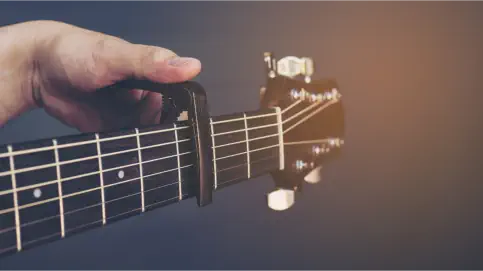
Fret Board, Chords And Capos

You Need to Know and Understand the Guitar Fretboard to Excel as a Guitar Player
The fretboard image above shows the string IDs on the left, with the low E string at the top and the high E string at the bottom. Across the top of the image are the fret positions, starting with the 1st “E” fret—which is the “open” E note (no strings depressed).
On the right side of the fretboard, you’ll see another E note. This position indicates that all notes on the fretboard repeat after the first 12 notes, but one octave higher in pitch. This higher octave position is usually only used by lead guitar players.
Fundamental Guitar Chord Relationships
For the vast majority of guitar players, there are only seven primary chords used when playing a song. These chords are E, A, D, C, F, G, and B.
In any three-chord song, these chords form a continuous circle: (E, A, D), (A, D, G), (D, G, C), (G, C, F), (C, F, B), (F, B, E), (B, E, A), and so on. This gives you seven primary chords and seven primary chord groups for any possible three-chord song. However, the most popular chord groups are (E, A, D), (C, F, G), and (E, A, B) – which is usually seen as (E, A, B7).
In practical use, the (E, A, D), (E, A, B), and (E, A, B7) chord groups are most often used for fast-moving songs because these chords have close finger groupings and are easier to play.
The chords (C, F, G) are most commonly used for slower songs because their fingerings are more difficult to play quickly.
There are many four-chord songs as well, but the most popular four-chord group used in songs is (C, Am, F, G).
The most common chords used alongside the primary seven chords are seventh chords and minor chords.
Chords beyond these basic groupings are usually added for piano players and are generally not necessary for guitar players. For the most part, they can be ignored.
What Is a Capo and How Do You Use It?
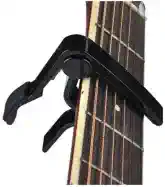
A capo is a small device that you attach to the guitar neck to shorten the length of all strings. This raises the overall pitch of the guitar; for example, placing a capo on the first fret raises the pitch by one semitone.
What Is the main purpose of a Capo
In the entertainment world, most songs require a vocalist and, musically, a guitar must support the vocalist.
The vocalists cannot alter their vocal range to match the guitar; the guitar must match the vocalists.
For example: If a song is played in the key of “A” and the singer cannot sing the “low” notes…
Don’t try changing chords; use a capo and move it up the fretboard (one fret at a time).
The capo increases the guitar pitch until the singer can sing the notes.
When I started learning guitar in the late 1960s, most players thought using a capo was cheating, so everyone wanted to learn barre chords.
Later, I discovered that recording studio musicians often used a capo when backing vocalists with different pitch ranges. So I thought: if professional musicians use a capo, I could too.
Looking at the image of the guitar fretboard above, you can see that the top “E” string is marked with note tags, starting with the “open” string of E. The distance between one fret and the next is called an increase of one semitone.
In practice: If you played a song using the open chord structure (meaning no capo) of A – D – E, and then placed a capo before the third fret, you would have raised the pitch by three semitones.
As a result, the A chord would sound like a C chord, the D chord would sound like an F, and the E chord would sound like a G.
Note: When you use a capo to raise the pitch by one semitone, every note and chord played afterward is also raised by one semitone. So, in the example above, raising the pitch by three semitones (making the A chord sound like a C) means all chords and notes are elevated by three semitones for the rest of the guitar.
Why use a capo instead of barre chords?
Using a capo to change the key allows you to play chords, melodies, and strumming styles quickly and easily. It also enables a variety of strumming techniques.
In contrast, barre chords are more difficult to learn and execute. They can make playing melodies and using multiple strumming styles nearly impossible. Barre chords may restrict your musical expression and slow your progress.
What if the chord pitch is too high or too low?
When you have difficulty finding the right chord pitch to match your vocal range, you’ll need to explore different chord groups, capo positions, and octave or harmonic ranges.
One trick I use is to find a single note that matches a part of my song, then try different chords that contain that particular note.
Understanding and using a capo is the heart and soul of my Quantum Guitar Method.
Using a capo allows you to play “open” chords (instead of barre chords) and gives you the freedom to do more than just strum chords. It also makes it easy to incorporate different strumming techniques, play single notes, and even play a song’s melody.
When you give yourself, your brain, and mind this freedom, a new world of self-expression opens. Your guitar playing will impress your audience and will seem (to you) as if the guitar is playing itself.